
2026 NAFSCE NATIONAL ASSEMBLY FOR FAMILY ENGAGEMENT IN EDUCATION
Toolkit: Family Math Conversations:
Building Thinking Through Dialogue
Thank you for joining Family Math Conversations: Building Thinking Through Dialogue with Dr. Michelle Pyo (LinkedIn) at the 2026 NAFSCE National Assembly! Family math isn’t about bringing school home. It’s about creating space for students to explain, families to contribute, and educators to learn from the thinking that becomes visible. This toolkit gathers the routines, prompts and resources from our session to help you move family math from homework monitoring to real mathematical conversation, in classrooms, schools, districts and homes.
📩 Ready for more? Complete the form at the bottom of the page to learn how we can team up to support your early math learners.
Routines from Our Session
1Notice → Infer → Wonder
A lens for listening to student thinking.
- Notice what the student actually said or showed.
- Infer what it might reveal about their reasoning, and treat that as a hypothesis.
- Wonder what you’d ask next.
2Family-Friendly Prompts
A prompt worth talking about has a low floor, multiple paths, student voice and family agency. Here are some questions any adult can ask, with no math expertise needed:
How did you figure that out? Can you show me with a drawing? Is there another way? How do you know it makes sense? Here’s how I thought about it. How is my way similar or different from yours?
3Homework Makeover
Turn “Complete problems 1–10. Parent signature required.” into a conversation.
Try instead: “Pick one problem that you’re proud of. Teach your strategy to someone at home. Then ask, ‘How would you solve it?’ Compare your two approaches. What is one thing you notice?”
4Listen for Strengths
Reframe common deficit language. Instead of “Families don’t know how to teach math,” try “Families have ways of reasoning and explaining we can build from.” The way we define the problem shapes the solution we design.
- If we assume: “Parents don’t care.” → We design reminders and compliance systems.
- If we ask instead: “Does this feel useful, doable, and meaningful?” → We redesign the experience.
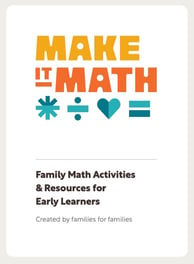
Family Math Every Day: Make It Math
Make It Math Family Activity Toolkit: Family math happens in the everyday moments families already share: cooking, shopping, playing, wondering. NAFSCE’s Family Math Advisory Council and parent and caregiver authors created Make It Math, a toolkit for families of children ages 3 through early elementary that turns these moments into math conversations.
How educators can use it: Pair it with the Family-Friendly Prompts above at a family math night, send home one activity a month in your unit newsletter, or share it with community partners like librarians to bring math talk beyond school.

Play-Based Math Games
- Math Myths vs. Facts (Spanish): Before you get started, mindset matters! Debunk harmful myths and reinforce that every student is a “math person.”
- K-8 Math Games with a Deck of Cards: These easy-to-play card games for grades K-8 help strengthen key math skills while fostering a growth mindset. Each game outlines the skills being strengthened and the number of players needed.

Strengthen Math Discourse
- Six Guiding Questions: Flip traditional roles and have students “be the teacher.” These prompts foster deep thinking, explanation, and clarity during homework time.
- Learning by Teaching Family Math Prompts (Spanish): Help families support math learning at home with questions that encourage reasoning and connection.

Connect Math to Daily Life
- Math is All Around Us: Invite your families to use this fridge-friendly resource to create fun math moments in everyday routines like cooking, shopping, and play.
- Family Math Interview (Spanish): Encourage students to interview a family member about how they use math in everyday life, sparking positive math conversations.
- Reflective Math Journaling: Encourage students to unpack their relationship with math through writing. Prompt students to reflect on past experiences, express emotions, and reimagine what’s possible in their math journey.
More Daily Math Routines to Try
Explore these everyday strategies that foster reasoning, agency, and joyful math conversation.
- Notice and Wonder: Invite students to observe a mathematical situation and share what they notice (facts, patterns, or features) and what they wonder (questions or curiosities).
- Which One is Unique: Present multiple items (numbers, shapes, graphs, etc.) and ask students to identify which one is unique and explain why. Every option can be argued as the outlier, promoting reasoning, justification, and multiple perspectives.
- Number of the Day: Share a single number and invite students to explore it in various ways, such as writing equations, identifying place value, or finding factors.
Further Learning
- Dear Math (Book): Co-authored by teacher Sarah Strong and student Gigi Butterfield, this book explores from hundreds of student letters.
- Math Mind (Book): Shalinee Sharma shows that the skills behind math success, like problem solving, logical thinking and persistence, can be taught to everyone.
- YouCubed (Website): YouCubed provides research-based teaching methods, mathematics tasks, videos, and ideas.
- Mathematics in Context: The Pedagogy of Liberation (Learning for Justice): Learn how math, when taught with radical love and cultural relevance, can empower marginalized students and challenge systems of injustice.
Let's Strengthen Early Grades Math Outcomes Together!
MathVoice is our evidence-based K-3 math practice tool that brings many of the strategies in this toolkit to life.

Step 1
The teacher assigns a standards-aligned MathVoice activity.

Step 2
The family partner receives a text message and/or email in their preferred language, and opens the activity in any browser. The family partner and child complete a math game together.

Step 3
Then, the family partner submits a brief video or audio file of the child answering a prompt to explain what they learned from the game.
These play-based activities strengthen math discourse, build growth mindsets, and surface student thinking—giving teachers insight into how students think about math, not just whether they got the right answer.